85 Years Later: The Deportation of Germans in the Soviet Union in 1941
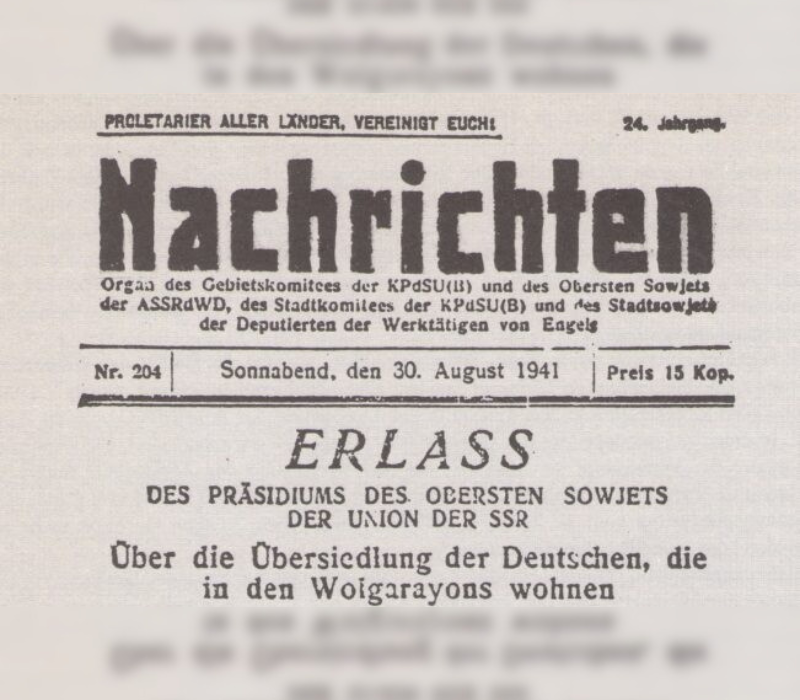
The deportations of 1941 marked the violent end of German settlement areas in the European part of the Soviet Union and in the Caucasus. They represented a dramatic rupture whose consequences are still felt today in the self-perception of those affected and their descendants. This applies in particular to the identity of the more than 2.5 million German citizens with a Russian-German immigration background. The conference examines the background, impacts, and consequences of the deportations and draws a connection to current issues of remembrance culture and integration.
The event is held under the patronage of, and with financial support from, the Federal Government Commissioner for Matters Related to Ethnic German Resettlers and National Minorities.
As part of the conference programme, the panel discussion "Deportation and Remembrance. The 85th Anniversary of the Forced Resettlement of Russian Germans in 1941" will take place on Friday, September 18, from 6:30 p.m., marking the anniversary of the deportations.
The conference will be held both on site at the Documentation Center for Displacement, Expulsion, Reconciliation and online via live stream.
An event organized by the Commission for Germans in and from Eastern Europe, Siberia, Central Asia, and the Caucasus, in cooperation with the Northeast Institute, Lüneburg; the Museum for Russian-German Cultural History, the Cultural Office for Russian-Germans, both Detmold; and the Documentation Center for Displacement, Expulsion, Reconciliation, Berlin.
PROGRAM
Friday, September 18, 2026
2.30 p.m, Welcome
Dr. Roland Borchers, Director of the Documentation Center for Displacement, Expulsion, Reconciliation
Introduction
Prof. Dr. Dietmar Neutatz, University of Freiburg
3.00 - 4.45 p.m., Panel 1
Dr. habil. Pavel Polian, Universität Freiburg, Ethnic Deportations as Stalin's Preferred Political Instrument
Dr. Alfred Eisfeld, Göttinger Arbeitskreis e.V., Background to the Decision to Deport the Germans in 1941Prof. Dr. Jan C. Behrends, European University Viadrina Frankfurt (Oder), "Fascism" as a Soviet Attribution in Long-Term Perspective
Discussion, modeated by Prof. Dr. Dietmar Neutatz, University Freiburg
4.45 - 5.00 p.m., Coffee break
5.00 - 6:10 p.m., Panel 2
Prof. Dr. Dietmar Neutatz, University of Freiburg, The Germans as a "Threat": longer-term Patterns of Perception
Prof. Dr. Dieter Pohl, , University of Klagenfurt, Aims and Methods of National Socialist Policy in the Occupied Territories of the Soviet Union
Discussion, moderated by PD Dr. Hans-Christian Petersen, Federal Institute for Culture and History of the Germans in Eastern Europe
6.30 p.m. Panel Discussion
Deportation and Remembrance. The 85th Anniversary of the Forced Resettlement of Russian Germans in 1941
Please register separately here for this event.
Saturday, September 19, 2026
9.00 - 10.30 a.m., Panel 3
Prof. Dr. Eva-Maria Auch, Humboldt University of Berlin, The Deportation of the Germans from Azerbaijan
Prof. Dr. Zaur Gasimov, Turkish-German University, Istanbul, The Deportation of the Crimean Tatars
Discussion, moderated by Dr. Alfred Eisfeld, Göttinger Arbeitskreis e.V.
10.30 - 11.00 a.m., Coffee break
11.00 - 12.30 a.m., Panel 4
Dr. Alfred Eisfeld, Göttinger Arbeitskreis e.V., Evacuation and "Repatriation" of the Remaining Black Sea Germans
Dr. Dmytro Myeshkov, Northeast Institute, Lüneburg, A Ukrainian-German Community in the Context of (Forced) Migrations of the 1930s–1960s
Discussion, moderated by Prof. Dr. Kirsten Bönker, Northeast Institute, Lüneburg
12.45 - 2.00 p.m., Break
2.00 - 3.45 p.m., Panel 5
Prof. Dr. Zhanna Kydyralina, Eurasian National University, Astana, Deployment in the Labour Army
Prof. Dr. Nelli Krasnobaeva, East Kazakhstan Technical University, Astana, Living Conditions in the Special Settlements (joining via video conference)
Johannes Dyck, , Museum for Russian-German Cultural History, Detmold, Religion and Religious Revival as a Survival Strategy
Discussion, moderated by Dr. Katharina Dück, Leibniz Institute for the German Language, Mannheim
3.45-4.15 p.m., Coffee break
4.15-6.00 p.m., Panel 6
Dr. Viktor Krieger, Bavarian Cultural Center for Germans from Russia, Nuremberg, The Problem of Soviet Perpetrators, Accomplices, and Collaborators: The Case of the Chelyabmetallurgstroy Forced Labour Camp, 1942–1946
Prof. Dr. Victor Dönninghaus, Northeast Institute, Lüneburg, The Search for Home: The Autonomy and Emigration Movements as a Long-Term Consequence of the Deportation
Dr. Katharina Dück, , Leibniz Institute for the German Language, Mannheim, Ruptures in the Language Biographies and Linguistic Identities of Germans in the States of the Former Soviet Union as a Result of the 1941 Deportations
Discussion, moderated by Kornelius Ens, Museum for Russian-German Cultural History, Detmold
Sunday, September 20, 2026
09.00 - 10.45 a.m., Panel 7
Prof. Dr. Andrii Kudriachenko, National Academy of Sciences of Ukraine, Kyiv, Ukrainian Historiography of the Deportations
Natalja Salnikova-Glaubitz, University of Freiburg, From Deportation to Migration? Museum Narratives of Russian-German History and Their Narrative Horizons in Germany and Russia
Edwin Warkentin, Cultural Office for Russian Germans, Detmold, Negotiating Collective Memory: Cultures of Remembrance Regarding the Fate of War Victims in a Transnational Comparison
Discussion, moderated by Dr. Dmytro Myeshkov, Northeast Institute, Lüneburg
10.45 - 11.00 a.m., Coffee break
11.00 a.m.- 12.10 p.m., Panel 8
Prof. Dr. Otto Luchterhandt, University of Hamburg, The Fate of War Consequences and the Reception of Ethnic German immigrants in Germany
Dr. Felix Riefer, University of Freiburg, The Kremlin's Ostensible Efforts on Behalf of Ethnic German Immigrants: Disinformation Amid Information Deficits
Discussion, moderated by Prof. Dr. Eva-Maria Auch, Humboldt University of Berlin
12.10 - 12.20 p.m., Break
12.20 - 13.30 p.m., Panel Discussion
Deportation as a Central Trauma and Identity-Forming Element for the Germans in and from Eastern Europe, Siberia, Central Asia, and the Caucasus
Dr. Katharina Dück, Leibniz Institute for the German Language, Mannheim
Dr. Alfred Eisfeld, Göttinger Arbeitskreis e.V.
Edwin Warkentin, Cultural Office for Russian Germans, Detmold
Moderated by Dr. Felix Riefer, University of Freiburg
FURTHER INFORMATION
Admission: September 18, 2026, from 2:00 p.m.; September 19 and 20, 2026, from 8:30 a.m.
Language: German
FREE ADMISSION
The event will be recorded and published on our YouTube channel Flucht, Vertreibung, Versöhnung.