


Long Night of Museums
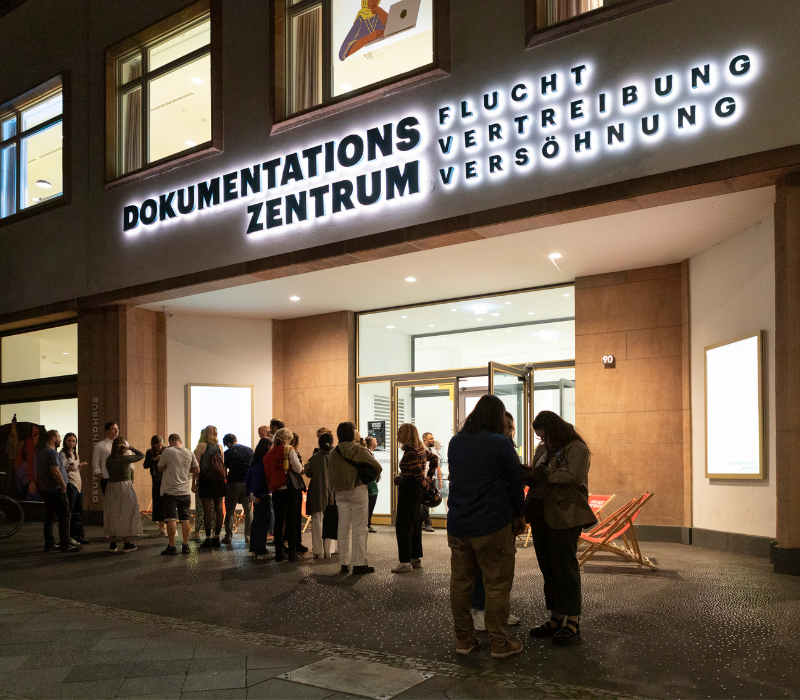
The Documentation Centre for Displacement, Expulsion and Reconciliation welcomes visitors on 29 August from 6 p.m. to 2 a.m. as part of the Long Night of Museums 2026, this year’s theme “Crime”.
Discover a unique place of remembrance, education and dialogue through a diverse programme of short guided tours, readings, performances, creative activities and live music. Join quiz tours, workshops on family history research, encounter mystical stilt-walkers, and music ranging from electronic and classical to traditional sounds throughout the evening. There is something for everyone to explore.
The theme of “Crime” is reflected in many different ways throughout the programme: through moving personal stories, gripping crime-fiction readings, artistic performances, thematic tours and an opportunity to decipher Sütterlin handwriting. Visitors can also look forward to a special culinary experience featuring specialities from Kreuzberger Himmel.
Advance tickets are available from the 3rd of August on via the Long Night of Museums Berlin website.
GUIDED TOURS
War and Crime: A Look Inside Our Evidence Room
6.30 – 7 p.m. / 11.30 p.m. – midnight (English), 10 – 10.30 p.m. / 11 – 11.30 p.m. (German), Meeting point: 1st floor
The tour explores wartime experiences, violent crimes, and their consequences through objects and documents. The tour also highlights how museums preserve, research and make evidence of violence accessible to the public.
What Happens When History Meets Modern Architecture?
6.30 – 7 / 8 – 8.30 p.m. (German), Meeting point: in front of the Room of Silence
From the historic, heritage-listed façade to the building’s modern exposed concrete structures, this architectural tour with Ticket B explores how past and present intersect at the Deutschlandhaus. It offers a fascinating behind-the-scenes look at the new Documentation Centre.
Displacement, Expulsion, Reconciliation. A Tour with the Director
7.30 – 8 p.m. (German) / 10 – 10.30 p.m. (English), Meeting point: 2nd floor
Dr. Roland Borchers will guide you through selected sections of the permanent exhibition. Showing objects, personal stories and historical examples, he will explore the themes of displacement, expulsion and reconciliation, while also offering insights into the work of the Foundation.
Strong and Vulnerable: Women in Displacement
7.30 – 8 p.m. (German) / 10.30 – 11 p.m. (English), Meeting point: 1st floor
More than half of all people who have been forced to flee or have been expelled are women and girls. Whether young or old, they face grave dangers, and many become victims of sexual violence. Through rare personal testimonies, this tour explores the realities and consequences of these experiences.
The Replacement and Expulsion of Germans
8 – 8.30 p.m. (German), Meeting point: 2nd floor
At the end of the Second World War, around 14 million Germans fled or were expelled in its aftermath. This tour presents personal stories and objects that illuminate the replacment and expulsion of Germans from the eastern territories of the German Reich and from East Central and South-Eastern Europe.
Global Perspectives on Forced Migration
8 – 8.30 p.m. (German) / 11 – 11.30 p.m. (English), Meeting point: 1st floor
This tour explores forced migration through examples from different historical periods and from a global perspective. It examines displacement, life in camps, and the consequences of war, violence and political upheaval.
OSTGEBIETE / ZIEMIE ZACHODNIE. German-Polish Perspectives: Curatorial Insights
6.30 – 7 p.m. / 9.30 – 10 p.m. / 10.30 – 11 p.m. / 11.30 p.m. – midnight (German), 7.30 – 8 p.m. / 8.30 – 9 p.m. (English), Meeting point: Foyer
This tour offers insights into the curatorial work behind the special exhibition. Through selected photographs, it explores themes of memory, loss, new beginnings and German-Polish history after the Second World War.
READINGS – Crime Fiction Night in the Library
In cooperation with the German Culture Forum for Eastern Europe
„Die Chroniken der Klara Schulz – die letzte Arie“
Reading and conversation with author Nadia Szagdaj and translator Paulina Schulz
7.30 – 8.15 p.m., Library, 1st floor
During a performance of The Magic Flute in Breslau in 1910, baritone Emmanuel Heiss dies under mysterious circumstances. Shortly afterwards, his lover, the prompter Henryk Skrocki, is found dead on the banks of the Oder. The clues point to an occult connection, drawing Klara Schulz into a dangerous investigation. A reading in Polish and German with translator Paulina Schulz.
Moderator: Ariane Afsari, German Culture Forum for Eastern Europe
„Die Feuer von Prag – Kisch ermittelt“
Reading and conversation with author Martin Becker
10.30 – 11.15 p.m., Library, 1st floor
Reporter Egon Erwin Kisch returns to the streets of Prague to investigate a new mystery. A burning ship on the Vltava draws him into the shadowy world of Colonel Redl, the Austro-Hungarian intelligence officer at the centre of the Habsburg Empire’s most famous espionage scandal. Tabea Soergel and Martin Becker present a gripping historical crime novel set on the eve of the First World War.
Moderator: Dr Vera Schneider, German Culture Forum for Eastern Europe
„Schatten über Königsberg“
Reading and conversation with author Ralf Thiesen
11.30 p.m. – 12.15 a.m., Library, 1st floor
Königsberg, September 1924. Detectives Aaron Singer and Heinrich Puschkat are called to investigate a mysterious death on the Baltic coast. A businessman lies dead among the reeds, while his boat drifts abandoned across the lagoon. Rich in atmosphere and historical detail, Ralf Thiesen’s crime novel transports readers to the Golden Twenties of East Prussia.
Moderator: Ariane Afsari, German Culture Forum for Eastern Europe
MUSIC
Beyond Borders and Belonging, ABAN Ensemble meets Live-Elektronik
6 – 6.45 p.m. / 8 – 8.45 p.m., Event Hall, Ground floor
The ABAN Ensemble collaborates with cellist and sound artist Golsana: Iranian tradition (Dastgāh) meets live electronics. Tar, oud, kamancheh, vocals, cello, percussion & Armenian duduk intertwine in a dialogue between acoustic heritage and electronic present – sound as a space of memory and transformation.
Mitra Behpoori: Tar (persian long-necked lute)
Roshanak Rafani: Percussion (tombak, daf, bendir)
Sara Hasti: Kamantscheh (persian spiked fiddle)
Fatemeh Dehghani (oud, vocals)
Golsana Shenasaei (live electronics, cello)
César Veas Valencia (duduk)
Alfred Schnittke: The Boundaries of 20th-Century Music
7.30 – 8 p.m. / 10 – 10.30 p.m., Event Hall, Ground floor
Award-winning violinist Salvatore Di Lorenzo and pianist Michael Cohen-Weißert perform works by Alfred Schnittke. The Volga German composer combined classical, modern, and avant-garde elements in his music. He also composed numerous film scores and is regarded as one of the most significant composers of the 20th century.
Hassan Elmalik & SUN BLUES
8.45 – 9.30 p.m. / midnight – 00.45 a.m., Workshop, 1st floor
Hassan Elmalik comes from the heart of Sudan, where the Blue and White Nile meet and the blues took root. A virtuoso on the oud, he blends musical influences from different continents and eras, developing a distinctive musical language that bridges Africa, the Middle East, and Europe, drawing on Sudanese tradition while incorporating avant-garde arrangements.
Hassan Elmalik: Vocals & Oud
David Blackburn: Percussion
Stefan Higgi Hickmann: Guitar
Ali Almansour: Bongos
Qusai Imad: Bass
Dennis Joseph Netto: Keyboard
Noirnor, Berlin via Kijiw / Ukraine
11.30 p.m. – midnight, Foyer, Ground floor
Noirnor is a Ukrainian artist now based in Berlin after fleeing the war. She's become a fixture on the city's club scene, playing Tresor, Watergate, Renate, and more. Known for her online sets on HÖR and Refuge Worldwide plus a monthly Rinse FM residency, she blends groovy basslines with intricate rhythms and immersive textures.
Balkantronika (live)
1 – 2 a.m., Foyer, Ground floor
Where modern electronic beats merge with traditional Balkan brass and swing instrumentation, the result is Balkantronika. These Berlin-based DJs and producers energize the dance floor with infectious electronic rhythms.
Asmir Hadžibeganović, DJ
Vit Polak, trumpeter
Massiv le Ghaza, MC
PERFORMANCES
Die Flugträumer – Mystical encounters
6 – 6.45 p.m., outside / 8.30 – 9.15 p.m., Foyer, ground floor / 11 – 11.45 p.m., Foyer, ground floor
Watch out for mysterious figures drifting among the guests. On towering stilts and with spellbinding juggling, they create brief moments of wonder, illusion, and a mystical atmosphere.
Diaries in Motion
7 – 7.30 p.m. / 9.30 – 10 p.m., Foyer, ground floor
Scenic Circus presents a circus performance featuring excerpts from the shows LYALKA and Diaries in Motion. Three young artists from Ukraine and Russia combine juggling, acrobatics, and dance in a powerful and inspiring piece of circus theatre exploring self-determination, freedom, and community.
MITMACH-AKTIVITÄTEN & WORKHOPS
Snapshots of Displacement – A Memory Game
6 p.m. – 2 a.m., Library, 1st Floor
Discover the illustrations of award-winning artist ‘Vikunia’ (aka Viktoria Cichoń) in our latest memory game. Her characters are inspired by the stories and objects in our exhibition and depict snapshots of people experiencing displacement. You can also see them on the windows of the Documentation Centre. Come along and discover the lovingly designed pairs of pictures as you play together!
Workshop: Traces Blown Away…? The Basics of Family History Research
6 – 7 p.m. / 8.30 – 9.30 p.m. (in German), Library, 1st floor
Where do you come from? Many people whose family histories have been shaped by flight or displacement are still searching for their roots today, particularly across the Oder–Neisse line. This workshop introduces methods for conducting successful genealogical research.
Deciphering Sütterlin – An Introduction with Gesa Füßle
6 – 10 p.m. (drop-in at any time), Wandelgang, 1st floor
Old manuscripts are not only linked to criminal cases – they can also reveal personal and historical family stories. Join Gesa Füßle to explore Sütterlin script, once used by millions of people. Learn to decipher historical letters and try writing in Sütterlin yourself, for example to read your ancestors’ correspondence.
Human Rights, Not Crime – How to Draw Anything with Carlotta Klee
6 – 8.30 p.m. / 9 p.m. – midnight (drop-in at any time), Wandelgang, 1st floor
What terms do we associate with human rights? Choose a concept from the Universal Declaration of Human Rights and, guided by Carlotta Klee, use chance-based drawing techniques to create spontaneous visual interpretations. Together, we will build a growing collective image of ideas, associations, and perspectives on freedom, dignity, and solidarity.
Quiz Tour – Take Part
6 p.m. – midnight (in German), Foyer, ground floor
Follow the clues and discover stories of displacement and expulsion. Gain fascinating insights along the way – and receive a small surprise when you submit a completed quiz sheet. Prize draws take place at 7, 8, 9, 10, 11 p.m., and midnight.
Drop-in: Making a Statement – Creating Peace Doves
6 p.m. – 2 a.m., Wandelgang, 1st floor
Make a creative statement for peace by designing your own peace dove. Choose a coloured sheet of paper and follow the step-by-step instructions to fold your dove.
CULINARY OFFERING
Culinary Delights at Kreuzberger Himmel
6 p.m. – 2 a.m.; Foyer, ground floor
Enjoy intercultural cuisine at Kreuzberger Himmel. Refugees from various countries prepare a selection of dishes, including vegan kibbeh, lentil kebabs, and sanbousak. This year’s special return dish: Königsberger Klopse – tender meatballs in a light caper sauce, originally from East Prussia.
A selection of refreshing beverages accompanies the culinary experience.